Go to todaysautisticmoment.com for the transcripts
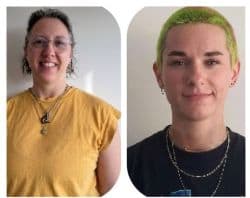
Hilary Otey and Coda Brucki are guests for this exciting episode from Queermunity. Queermunity is an AuDHD Queer owned community center made by and for Neurodivergent Queer people. Whether you are looking for a sandwich, snack or beverage, a space where you can hear yourself talk or hear, and just be yourself, the staff at Queermunity have made their establishment safe for you. Hilary and Coda talk with Philip about what the did to make Queermunity a safe space, and what they do to maintain it so that Neurodivergent Queer people feel welcome and accepted there.
Dyslexia Accessible Transcript
Maintaining Safe Autistic Queer Spaces
Spanish Accessible Transcript
Cómo mantener espacios seguros para personas autistas y queer.
German Accessible Transcript
Sichere Räume für autistische queere Menschen schaffen
French Accessible Transcript
Maintenir des espaces sûrs pour les personnes autistes et queer
Chinese Simplified Accessible Transcript
Transcript
Maintaining Safe Autistic Queer Spaces
June 28th, 2026
Episode Introduction and Preview
Welcome to Today’s Autistic Moment: A Podcast for Autistic Adults by An Autistic Adult. My name is Philip King-Lowe my pronouns are he/him. I am the owner, producer and host and I am an Autistic Adult. Thank you so very much for listening.
Over the past few years, many Autistic Queer people have led initiatives to create safe Autistic Queer Spaces by us and for us. Many of us have worked hard to make our spaces sensory accessible with room for our diverse communities. The current political and social climate has made it more challenging to maintain those safe spaces so that Neurodivergent Queer people can just be themselves.
In a few moments Hilary Otey and Coda Brucki from Queermunity will join us to talk about how they have made their establishment a safe Autistic Queer space and what they do to maintain it that way.
Come join us for the episode Maintaining Safe Autistic Queer Spaces on Today’s Autistic Moment.
♫♫ Opening Theme Music ♫♫
Segment 1
This first segment of Today’s Autistic Moment is sponsored by The Autism Society of Minnesota, known as AuSM throughout Minnesota’s Autism Community. As Minnesota’s First Autism Resource for more than 50 years, AuSM serves the whole state, the whole spectrum for the whole life. Visit AuSM at ausm.org.
In addition to the wonderful guests and conversations on Today’s Autistic Moment, you can find many more resources.
Visit todaysautisticmoment.com to listen to over 120 episodes released since 2021.
Check out the Episode Schedule 2026 to see upcoming shows, topics, guest information, and program descriptions for season 6.
On the website, you can:
· Learn more about Today’s Autistic Moment.
· Read the guest bios pages.
· Explore the Adult Autism Resources Links Page.
· Visit the Autistic Community Bulletin Board.
· Read the blog.
· Find out about TAM Autistic Consulting Services.
· Sign up for a subscription to get Ad Free Interviews.
· Support Today’s Autistic Moment with a donation.
Every episode, including this one, has a transcript. The transcripts are sponsored by Minnesota Independence College & Community.
You can read the transcripts right on the website or download printable versions to help you save ink.
The transcripts have hyperlinks in them for names, organizations and other resources named throughout the show that you can access to see if they are helpful to you.
The transcripts use a dyslexia-friendly font that are available in English, Spanish, German, French, and Chinese Simplified.
Want more interaction with Today’s Autistic Moment? Follow Today’s Autistic Moment on Facebook including our Community Group Page, LinkedIn, BlueSky, Instagram and Threads. Also follow us on the YouTube Channel @todaysautisticmoment to listen to new episodes of Today’s Autistic Moment and watch Autistic Voices Roundtable Discussions.
Last weekend, on June 20th, Today’s Autistic Moment produced a live broadcast from Queermunity during their Pride event Quiet Riot. The recording of the broadcast is available on the YouTube Channel @todaysautisticmoment. This episode caveats from Quiet Riot during which Hilary Otey and Coda Brucki will join me after this first commercial break when we will present Maintaining Safe Autistic Queer Spaces on Today’s Autistic Moment.
♫ Segment Ending Music ♫
Commercial Break I
Podcast Apps
Today’s Autistic Moment can be downloaded and heard on most podcast apps including Apple. Google Play. Breaker. Castbox. Overcast. iHeartRadio. Pocket Casts. RadioPublic. Spotify. TuneIn. Pandora. Amazon Music. Audible. Podcast Addict. Podcast Chaser. If you are looking for the transcripts, go to todaysautisticmoment.com, click on the episode you want to listen to and follow the directions to find the transcripts.
Thank you for listening to Today’s Autistic Moment.
♫Best Care Ad♫
♫MICC Ad♫
♫ Lisa Morgan Consulting Ad ♫
♫Segment Beginning Music♫
Segment 2
Philip King-Lowe
Hilary Otey (she/her) handles the day-to-day operations of Queermunity. Originally from Oklahoma, Hilary made her way to the Twin Cities via Boston in 2010. She’s collected a bit (a lot) of experience that supports her Queermunity work like a BA in Sociology and Gender Studies, and an MBA, background in program development, fundraising and more.
Please join me as I welcome Hilary Otey to Today’s Autistic Moment as she will share how Queermunity got started and has become so successful.
Philip King-Lowe (He, Him, His)
Hilary Otey, thank you so much for being with us on Today's Autistic Moment. It is a pleasure to have you as a guest today. So welcome.
Hilary Otey (she/her)
Thank you for having me. I'm happy to be here.
Philip King-Lowe
Yeah, thank you. So, Queermunity. I was there in March, and when I got the tour from your support staff and I saw everything that's there, I was amazed. I was blown away. I was like, somebody thought to do this, you know, all this. And so I was just blown away. And so I had to get you and your staff on board for this show today. Please tell us about how you and your spouse made Queermunity, and tell us all the wonderful things about your establishment.
Hilary Otey (she/her)
Great. Thank you. Thanks, Philip, that's a big question, and I'll do my best if I forget anything. Please, please let me know. But Well, I first would like to say that Queermunity has been a labor of love of dozens and dozens and dozens of people, not just me and my wife, but it the whole project started a few years ago when, well, quite a few years ago now, actually, after COVID, you know, I, I and my wife started talking about and thinking about, you know, how does, how does a community heal from this type of social isolation? And, you know, challenges of being together and forming community and staying socially connected, especially when those, there are other challenges to doing those, even before COVID, and outside of COVID, you know? And so it just kind of was more of like an intellectual exploration for me, of like, what does that mean? What does that look like? And I started then doing some Googling, like, Well, where are the physical spaces that people are going to come back to once it is safe or safer to safer to read, you know, connect in person? And just realizing that the Twin Cities was one of the only, only major metropolitan areas in the country that did not have an LGBTQ+ center. So there are about 300 LGBTQ+ centers across the United States, and Minnesota had none. And just for context, I grew up in Oklahoma, so I'm from Oklahoma. I moved when I was 18. I moved out of there when I was 18, but there are two LGBTQ centers in Oklahoma, and we had none here in Minnesota, despite having a really high queer and trans population.
Philip King-Lowe
Please talk about the Neurodivergent side of this, because your community is so supportive of us.
Hilary Otey (she/her)
Yeah. And I think, you know, that's where we started exploring, why do we not have a place to gather, and what are the places that we can gather. And you know, that's where the conversations happened about, what would an accessible place look like, right? And so for me, you know, there's nothing wrong with the big Pride celebration is great for a lot of people, or going out to bars is great for a lot of people, but it's not great for everyone, and it's not necessarily a setting or an environment that's conducive to building those connections or having a regulated and a regulated nervous system for a lot of us. So that's where we started exploring like, what would a space look like that was more accessible to more people? And our the team that we had, the steering committee team, was a wonderful team, and made up of people of all different kind of experiences, neurotypes, backgrounds, identities. It was a really great a really great team that helped us think about things from a lot of different angles, and we did an accessibility audit with some disability justice advocates and leaders, and just really understanding what are all of the different considerations that we might not be thinking of. But then we also have our team, which is a very Neurodiverse team, and so we got to also put our own, you know, input into what we would like to see or what would work for us or our friends or our loved ones, in terms of both the space and the programming. So when we were looking around for spaces, we needed to have space that had all gender neutral restrooms. That was important. We also needed to do a lot of work to the space to meet different needs. So we put in, we put in a whole new front door and door paddle so that the door was more accessible. The space has an elevator and then for sound blocking and masking, so that the sound doesn't become overwhelming or over stimulating. We put in acoustic panels in the ceiling. We have acoustic panels hung around the space inside, and then we installed a sound blocking speaker system, which for most people, they can't notice. I'm very sensitive to those, like electric electronic sounds, and it doesn't bother me. It's more of like a white noise or a gray noise, that helps balance any echoing or any kind of talking in the background. So we've we kind of thought about what would make the space feel comfortable for the most people, and that's kind of the physical part of it. There's other things that we've done too, but then with the programming piece too, we thought about and partnered with a lot of groups who also think about, what do folks want and need that's not being offered? So that's really where what we're trying to focus on, we're not trying to do the same thing as everyone else or compete with other awesome offerings and spaces in the community. But did notice and want to address some of those gaps that the other spaces and places and offerings don't, don't really provide or don't look at. And those are, you know, lower sensory and accessible events that are free or low cost, where folks can use their creativity, and that's really focused on, you know, the strengths of everyone in our community, and highlighting those strengths and those opportunities for self-expression, and the ways that that there are different and valid ways to connect and stay connected and participate. So we have a range of programming from monthly puzzling, for example, where we do community puzzles, and it's a great way to just, you know, kind of be in be in community, and be in space with others, and you don't necessarily have to talk. You can if you want. You can participate as little or as much as you want. But we have puzzling monthly we have Friday Friend Labs, which is a great way to bring your own craft. And we also have at Friday Friend Lab; there's also a lot of skill sharing that happens. So somebody would be like, Oh, that's a cool that's a cool crochet technique. Can you show me? So it's a great way to kind of connect with others. So all of the events that we have are on our website or on our app, so folks can look through and try to find what works for them and what would be a good fit for them. And then I would be remiss if I didn't mention our big annual event that we have coming up called Quiet Riot, which is a sensory, friendly Pride celebration. It's a quiet celebration of loud identities, is what we call it, and it's a full day of workshops and events and activities, all with a sensory friendly or low sensory kind of idea behind it, and all of the workshops and activities are provided by other folks in the community who are Neurodiverse. So it's like you. And we have some people who run their own coaching businesses and people who run their own, arts, businesses, poets, artists, just a range of ADHD and Autistic and AuDHD folks who want to just share what they have to offer with other folks in the community.
Philip King-Lowe
What I really loved when I was there is you've got these separate sections. You've got these lounge areas. You have another area where there's a couch, where people can maybe study or where there's bookshelves and a couch, and it's well carpeted, so the sound in there isn't, you know, is also kind of protected, but and then you have the game area. You have all these different areas, and you have areas that can be used for a sensory safe space, for example, you have all of these different things in this one space. And I thought to myself when I saw it, I was like, this is incredible. Whatever you're here to do, you can probably find a space for yourself to do what you want to do in that space. And again, when I was eating in your cafe, I was like, the sound isn't reverberating in here, you can actually hear yourself talk to someone else. That was one of those things I really appreciated. And like I say, it was one of those things where I was just like, I just love this, because there's something in here for anybody who really wants to quote escape for a while, but still wants to have some kind of social connection, and it's just okay to be you and have if you need something, you can find it here and that sort of thing for the benefit of this particular show where we're talking about maintaining safe autistic queer spaces before Coda comes on, can you talk a little bit about what it's been like for you and the staff to maintain this as a safe space?
Hilary Otey (she/her)
Yeah, we have, you know, we think about that in a lot of different ways. So there's the physical safety and then the emotional and psychological safety, right? So, different kind of ways of thinking about it, with the physical safety that's obviously extremely important for us. We have, luckily, never had like a real safety issue in terms of, like violence or, you know, as a bad actor coming in. So we were very grateful for that. We do have safety issues with you know how some folks who visit are using the space. We've had to make sure that the restrooms were being used by folks who are using who are at Queermunity to participate in the programs. And I think that that's kind of a very common thing for a lot of businesses and organizations in the neighborhood where folks are looking for public facilities. And so we've had, we had a couple, you know, things that we've had to change in our operations to maintain safety, to make sure that there was not being, there's not drug use in the bathrooms and things like that. And we're, we've, I think, we've figured out how to make sure that we can strike that balance of safe, physical safety. We also, you know, we're changed some of our operations during Metro Surge, where we had the door locked a lot more and used the doorbell to make sure that that the space was safe. So sometimes, if there are larger events or private events, or if we, you know, have a lower staff number, we do keep the door locked and use the doorbell, just to make sure that, you know, we are always keeping in that physical safety in mind, but in terms of psychological safety, I think that, obviously that's a priority that we've all talked about, and I have to admit, I think it also comes kind of intuitively or naturally from just our team, because we have such diversity in our team, in all different and gender identities and neurotypes and experiences and ethnic backgrounds, cultural backgrounds, and our team, my team members, my coworkers are they're just so kind, and they're always thinking about how to serve community. How do we make people feel welcome? One of the things that we do is we make sure people are greeted when they come in, so that they know that they're welcome and that they're in the right place, and that they're greeted by someone, either a staff member or volunteer. We have about 50 regular volunteers who do a shift per month. We could not do Queermunity without our volunteers. We are so grateful for them, and most of those volunteers do work at the front desk to help provide that that welcome and that sense of belonging when folks come in. So the majority of the people that are at the front desk are volunteers who are just there to try to make sure people feel welcome and safe. And I think, you know, we want to make sure that all of our events are accessible, and when, when we have signups, we often ask, What were people's accessibility needs and so, you know, so forth. So I think that that helps folks know that that we want to make sure that we're meeting, meeting their needs, if we're able to.
Philip King-Lowe
You and I talked about a month ago, you mentioned some concerns because of funding to maintain your disability accessibility. Can you just talk briefly about that?
Hilary Otey (she/her)
Sure. Yeah, I think you know, our funding challenges impact disability accessibility as well as just general accessibility. As you know, if we are meeting the needs of folks who are disabled or their specific accommodation needs, then that actually benefits everyone. So, but our funding challenges, have you know, persisted, and Metro Surge really was a big hit for us, as it was for a lot of small businesses and organizations. With so many mutual aid needs, and the focus on keeping our community members safe and fed and those basic necessities, as well as just rising costs and inflation. That combination has really impacted a lot of our business, a lot of our sales, all of our events, well, all but one of our events in January and February were canceled. Our partners canceled their events because of, you know, safety concerns, which is legitimate, but that trickled down. We also had a contract with the City of Minneapolis, and that contract was canceled to reallocate some funding to pay for law enforcement, for Metro Surge. So that that has just impacted our staff, our staffing, you know, the hours that we have for staff and the therefore the ability that we have to do the like range of programming that we want to do
Philip King-Lowe
Well, my reflection continues to be that Queermunity is doing a marvelous job at community building and helping people find friendships and opportunities to meet new people, or bring the people you're comfortable with into a space that is very safe and very alive, with lots of advocacy work in its own way. And you know when I when I saw that space and our communication since then. I mean, it's something that I felt we had to get behind because, you know you shared with me yourself that many people have been to Pride events, or even the Pride festival and the loud music, the large crowds and the weather, combined with all of the overwhelming interactions really do make a difference. And that Queermunity created this Quiet Riot to be an alternative to that, so that if someone just it just doesn't work to be at the Pride festival, they can go to Quiet Riot at Queermunity and find a space that works for them.
Hilary Otey (she/her)
Yeah, yeah, exactly that. That was my hope. And, I mean, it is a little selfish, because I wanted it for me. But also, you know, I have experienced going to the big Pride festival with one of my mentors, who uses a wheelchair, and I was pushing her, and it's practically impossible, as you probably know, to get through those crowds, and we almost ended up in a ditch. And I was like, there. There has to be some other place that's age friendly. I also have a kiddo all, all of my kids are Neurodiverse, and one specifically has a lot of dysautonomia and just cannot manage their regulate their temperature, their body temperature. So being outside in that heat is that can actually be pretty dangerous, yeah, and that's also my, my one queer kid, one that least, who has told me that they are, and I was like, Well, where can, where could we go that they could be included, and it's in the air conditioning and not too loud and safe. And so I, you know, I know that it's not just me who knew that kind of experience, and so that's what we're hoping for, is a range of, you know, experiences and fun. It's different. It's not the same. It's not the same type of thing where you go and get a bunch of swag, and we'll have some performances, but it's there'll be, you know, a little bit quieter, and we'll have some dancing. We'll have line dancing, so no touching required, if you don't want to. But we'll, we're having a teacher come and teach some dance moves so everybody can feel included, and also get out there and move your body if you want to.
Philip King-Lowe
Hilary, I am so grateful that you've stopped by to spend some time with us today, and even though this particular show will be is coming up after this year's Quiet Riot, I would encourage everybody to look up queermunity.com and find out about all of the wonderful things that are happening and for all the opportunities you can. And Coda is coming right up after this next commercial break to talk a little bit more about what Queermunity does and all the great things that happen here. Hilary, thank you so much for stopping by today. We appreciate it. So much
Hilary Otey (she/her)
Thank you for having me. Philip, appreciate it.
Philip King-Lowe
You're welcome.
Philip King-Lowe
Following this next commercial break, Coda Brucki will join me to talk more about how Queermunity has been meeting the needs of the intersectional communities that walk through their doors.
Transcribed by https://otter.ai
♫ Segment Ending Music ♫
Commercial Break II
♫ Looking Forward Life Coaching Ad ♫
♫ July 4th Public Service Announcement♫
♫ Queermunity Ad♫
TAM Support Ad
Today’s Autistic Moment is a podcast that is hosted by an Autistic Adult with other Autistic Adults as guests. Autistic Adults are the best experts about sharing our stories. Our stories come from lived experiences. When we share our stories as Autistic Adults on Today’s Autistic Moment we discover community through validation with a Neuro-affirming approach to thriving and not just surviving in our identity.
Today’s Autistic Moment needs your contributions to continue sharing the stories of the Autistic Adult intersectional communities.
Support Today’s Autistic Moment in any of the following ways.
· Make a one-time donation through the Ko-fi icon when you tap on Support Today's Autistic Moment on todaysautisticmoment.com
· Subscribe monthly via Patreon.
· Purchase items at Today’s Autistic Moment’s Logo Shop.
· Share Today’s Autistic Moment with your family, friends, coworkers and others through social media and/or by telling others about us.
· If you own a business and/or work with an organization that supports Autistic intersectional individuals by encouraging them to live with pride in who they are, advertising opportunities to support Today’s Autistic Moment are available. Please send an email to todaysautisticmoment@gmail.com for more information.
Donations are not tax-deductible but help keep Today’s Autistic Moment as a safe space.
Thank you for supporting Today’s Autistic Moment.
♫Segment Beginning Music♫
Segment 3
Philip King-Lowe
Coda Brucki (he/they) is Queermunity’s in-house graphic designer and event scheduler, bringing a sharp eye for details and a love of visual storytelling to everything he touches. Originally from Illinois, Coda studied interdisciplinary design in Iowa before making the move to Minnesota in 2017. Outside of work, he’s the proud cat dad to Pancake-who, he jokes, is more of a burnt pancake.
Please join me as I welcome Coda Brucki to Today’s Autistic Moment to tell us how Queermunity has been meeting the needs of the many Neurodivergent Queer customers who visit the establishment.
Philip King-Lowe
Coda Brucki, welcome to Today's Autistic Moment. I am so glad that you've taken time to join us today. So, welcome.
Coda Brucki
Yeah, thank you for having me.
Philip King-Lowe
You're welcome, Coda. We just heard from Hilary about how Queermunity was established and the services it offers in terms of Queer AuDHD people, and so now I'd like you to talk about your involvement at Queermunity, and what that means for you.
Coda Brucki
Yeah, so I started volunteering pretty soon after Queermunity had opened. It was about a month after that, quickly kind of turned into me working there, and for me personally, Queermunity honestly helped a lot with me coming to actually accept my AuDHD side, because that was something that I kind of, I had trouble with, like masking a lot, and especially in like a work environment I had never been in a place that was really accepting of like my sensory needs and things like that and so for me being a community and having it being a safe space for Autistic individuals and Queer individuals it's really kind of helped me learn about myself and also sorry, it's kind of, thank you. It's helped me just like come to accept that side of me, and see that it's something that can be easily accommodated. I always kind of was like I said, at a hard time in other workplaces doing that was something that was accommodated, but between things of like making sure we always have like either low lighting or lights that can be like changed in color or dimmable or like just low noises or having earplugs available, those are things that are really easy to implement and we have, and yeah, it's just been really great to like see it be so normalized. I guess that's the thing that Queermunity has really done, is it made me feel like being Autistic is just normal, which it is. It is a normal thing, but when you're not used to that, it can seem very like an alien thing, like that, like, hey, this can be something that is easily countable. It's just part of life. Other people do experience it. Yeah, so that's what I love about Queermunity, and is that it's just it's a place for people to just go and just be themselves and become comfortable with just being open and being themselves.
Philip King-Lowe
And I don't think, no, I do think that we need to acknowledge that even being in some queer spaces where our AuDHD identity is also welcomed can be a challenge, and what I love about Queermunity is it's found its way to allow both parts of our identity to exist and feel like we can be comfortable there, we can be ourselves, we can be engaged in things that are going on around us. What do you think?
Coda Brucki
I definitely agree with that, like you said, there's not a lot of spaces that seem to have that overlap between being very openly and obviously you know cater to queer identities, but also catered to Autistic identities, there might be like smaller groups that kind of try to it, but there's no specific space that holds that, and so we're very unique in that sense, but I do hope to see more spaces like this become a thing.
Philip King-Lowe
Right. Yeah, I agree. Yeah, and one that's not heavily invested in the loud music and crowded spaces, although I'm sure you have some of that that goes on there, but point is, is that is that it's okay if something like that doesn't work for each individual person. You have spaces where someone can remove themselves from that if necessary, or you know, you, what I really loved when I visited there is that you've got these little spaces, like I saw a few lounge areas where they're removed from the main part of the cafe area, so that you know if a group wants to go over there and study for a project, or if they just want to hang out there and read a book, or just talk about a book, or talk about a special interest, they can do that, you know, I saw, I saw two spaces, and then you've got the gaming area and the working areas, the offices that are open, and the safe space room, if one wants to use, use it. I mean, I still just, I'm awed at how much diversity that is just in the physical space, where people can go and be and do whatever they wish, within reason, of course.
Coda Brucki
And that's the thing, is like you said, you know, some events we try to keep, low sound on, but there are some events that you know the entire space is being used, and like there's might be used, if someone ever comes up to the front desk, is like, "Hey, I'm feeling, you know, kind of overwhelmed right now, is there a space that I can go that I need to calm down? We always make sure there's some place available, and we're like, it's a normal thing for us, for because we get on staff, pretty much everyone is some sort of Neurodivergent. A lot of us are, you know, Autistic or AuDHD, or have sensory issues. So, like, we completely understand if someone comes up, it's like, "Hey, I'm feeling, you know, sensory overload, I need a space right now. Right away, we're like, "Yep, we got you, we'll find you a space. Either one of them says aren't being used, or if everything's being used, we have a set space that's, you know, that's what it's meant for. So we do try to keep things like I said in the space as diverse as possible to accommodate a lot of different needs, whether it's a disability or a sensory issue, anything like that, and we're always prepared to make further accommodations if it's needed.
Philip King-Lowe
You know, like I say, I, my visit there in late March, it was a Friday afternoon, and it wasn't terribly crowded yet, but I just remember being in the space, and I'm, I was looking around there, and I thought, oh my, I just was like, I've not seen anything like this before, and I wish I had seen something like this before, but we have this, these people who have thought of just about everything they can. You know, and so one of your volunteers came, gave us a tour, and what I saw was, was incredible. I just, you know, it was so, so well suited for the Queer Neurodivergent communities. Today's Autistic Moment was present for Quiet Riot, and Hilary gave us a tour, so that to that sort of thing, and like I say, it just was like amazing that how much you all thought to put together. So what is it like for you to be there and tell us about the efforts that you make to maintain that a safe Neurodivergent space.
Coda Brucki
Like I said, we're always willing to jump in with extra combinations needed. It's a very.. we've made it so our goal is to hopefully make it so that it feels like a normal and safe thing to do is to come up and ask for accommodations, whether it's earplugs or you need your overall to need a separate space or anything, I mean, we've had people who come up and they don't talk, and they'll just start writing just on Notepad, and we'll.. it's not.. it's not made to be anything, you know, weird or extra, because we're just used to.. we're just like, yes, this is safe, you can do that. You come up and start writing to me on a notepad, I'm not going to question it, I'm just going to start writing back to you, like things like that. Is our goal is to just make it so everyone feels that they can just truly be themselves in whatever way they are, and that's okay,
Philip King-Lowe
Are there challenges to maintaining it that way that you can talk about?
Coda Brucki
Yeah, so in the sense that we are, you know, partially an event space, sometimes we will have multiple different, like smaller groups or events, or like have louder music playing, or might need lighting a certain way, versus another group might, you know, not want that, or might have issues with that. So finding what to basically accommodate everything, that's why I have, like, the sound panel is trying to help, you know, separate things a little, that's why we have multiple different, like ways lights can be put up and stuff like that, so it's challenging those sometimes to juggle, especially if like groups needs like a juggling act with that. Yeah, I say that's probably what accommodating multiple groups needs at the same time, and then, of course, you know, sometimes there can become conflicts with that, misunderstandings, so that, but I think we've done a pretty good job with it.
Philip King-Lowe
Yeah, and what was it like to maintain that space during Operation Metro Surge?
Coda Brucki
It did, in a sense that everyone was definitely stressed and on high alert, you know, everyone's nervous systems were kind of on edge. So it was just trying to make it feel like a safe space when no one felt safe in general. Just being in the city, it just, you felt it didn't feel safe. So, trying to make some place as a safe space when nothing feels safe, that was really difficult. But yeah, and so trying to make also people know that, like, hey, you are welcome here, it's okay, we're gonna do whatever we can to protect you, should something happen, because we do, we are a very, you know, diverse space, so people heavily been impacted by what was going on. You know, we want to make sure that they will do whatever we could to keep them safe. So, that was definitely a challenge, and just trying to make that known, that's like, hey, you're safe here, and we're going to try and make this stay as safe as possible, and stay as you know, grounding and comforting as possible in a time where everything feels chaotic.
Philip King-Lowe
Yeah, and did you find some really challenges since the diverse population there, as far as culturally speaking and racially speaking, what kinds of challenges did you meet there?
Coda Brucki
I mean, there's been fortunately, we have a couple people who speak Spanish that have helped out there. We also have ASL interpretation app that's like on standby, that's, you know, readily available. So we haven't actually, at least in my experience, I've seen too many complications when it comes to like language, you know, becoming an issue, but that's just me personally. I don't know if maybe I haven't heard of any of my co-workers really having that much of an issue either, but yeah, we've haven't seen too much of that being complicated, but it is something that we're always kind of, you know, try to be prepared for, in terms of just, you know, having resources where if you don't speak a language that someone on staff speaks, is there somebody else we know that could help? We make sure a lot of our information is available in Somali and Spanish as well, so we try to, we try to make things as language accessible as possible.
Coming up after this final commercial break, Coda will talk about many of the events and resources available at Queermunity to give those in need some important items for their daily living. Today’s Autistic Community Bulletin Board will follow.
♫ Segment Ending Music ♫
Commercial Break III
♫ Actually Autistic Coach Collective Ad ♫
TAM Autistic Consulting Services Ad
If you have just learned that you are Autistic, you are probably getting information from many places. Some of the input is not affirming. You are hearing phrases like “You are too high functioning to have Autism.” “No wonder you sit around and do nothing all day.” You have people suggesting therapies and ways to be “cured.” What if you could talk with someone who is Autistic and proud of who they are? Where can you talk with an Autistic who will validate you and help you find Neuro-affirming resources? I can talk with you and assist you with helpful advice.
TAM Autistic Consultation Services are not therapy or legal advice. My consultation services offers you education supports, with recommendations to people and resources to see if they will work for you.
Go to todaysautisticmoment.com and read about TAM Autistic Consulting Services. If interested, please fill out the intake form and make an appointment so we can begin working together.
♫ ITI Assistive Technology Ad ♫
Future Shows
The fourth Annual Summer of Self-Care Series begins on July 12th with Dr. Megan Anna Neff on the episode Self-Care: Managing Your Nervous System. Managing our nervous system is a first priority for Autistic individuals. Whether Autistics experience pain, feel over tired, or are experiencing sensory distress; our nervous system is triggering our bodies’ response. Megan is an Autistic therapist and author. Megan will help us better understand our nervous system with management suggestions.
On July 26th, Carole Jean-Whittington will be my guest for the episode Self-Care: Practicing the Pause.
On August 9th, Dr. Jessica Hicksted will be my guest for Self-Care: Navigating Trust.
Remember to visit the Episode Schedule 2026 Page on todaysautisticmoment.com for more details.
Thank you for listening to Today’s Autistic Moment.
♫Segment Beginning Music♫
Segment 4
Philip King-Lowe
I'm also interested to have you talk about the valuable resources you have there, like your community resource wall, you have referrals to affirming care, you have the healing centered programs there, your website is full of stuff about things like gender affirming gear, you know, basic needs supplies, health essentials, other supports. Please elaborate on that, because that is so very important right now for our communities.
Coda Brucki
So, for our community wall, it's pretty much anyone can come and post, you know, their own events. It's a great place for people to come and see what else there is in the community, whether it's on events, whether it's people just I've seen everything from, you know, people just, hey, I just want to hang out to events to things like people selling their services, in terms of like photography or artwork, or sometimes it's just like getting to know people, so there's kind of everything on that board, so that's really great. A lot of people come into, like, "Hey, I'm new to the city, and I don't know anything about here, and I'm like, "Hey, have you checked out this community board? It's kind of like,
Philip King-Lowe
Yeah.
Coda Brucki
It's this, you know, everyone who comes in here is probably part of the same community you're in, you know, either they're queer, never a divergent, or both, and they post on this board, come find, you know, other things to do in terms of our resource wall behind that, like it's got free, like hygiene items, so if anyone's struggling, or just, you know, they just need something, they're free to take it. They don't ask questions or anything like that. We do have our gender affirming gear, so like, we can't, if anyone's on like HRT, we can't give the actual hormones, but we can help supply the like needles and like alcohol pads, stuff like that, so we can help with that. And then we have a Trans Resilience Night, so pretty much anyone, gender non-conforming, you know, trans, non-binary, anything in between, you can come and take just whatever you need. Again, we don't ask questions, it's meant for you to come take what you want to feel good about yourself. Then we have a lot of things that kind of overlap with being, you know, part of the LGBTQ+ community, plus also being Neurodivergent. So we have, we've partnered a lot with, like, Brave Mental Health to host a lot of workshops. One of them was just like a body doubling thing, another one was like specifically for like trans mask individuals, so that's something we've had a lot of workshops like that, and then we also have Mangata Healing, which is actually in community, and they're going to start doing community acupuncture on the first and third Wednesdays of each month, but they're really cool, so they do obviously acupuncture, but they are really knowledgeable, and specifically how trans or gender non-conforming and neurotypical folks, how their bodies operate, and how it might be different to, like, a neuro-typical person, which I think is really cool. And then I definitely think something was needed, you know, because, you know, gender non-conforming and Neurodivergent people, you know, we might hold stress differently in our bodies than someone who isn't, and I feel like a lot of normal health practices don't necessarily account for that, and so, like, my got to healing is really cool, and that, like, they're really well, those differences, and very trauma-informed. So, yeah, so we have a lot of really cool partners and things in our space.
Philip King-Lowe
Well, I happen to hold the belief that regardless of what one's gender is, that or even sexual orientation is, is that Neurodivergent people are by nature gender nonconforming because of we really kind of bust apart all stereotypes when it comes to gender. You know, I mean, I've interviewed a lot of straight Autistic women who were once told that they're tomboys, and I've had, you know, other straight Autistic men who are, quite frankly, by the male stereotype, over sensitive, you know, that sort of thing, so I really do think that they, they all overlap.
Coda Brucki
There's definitely an overlap.
Philip King-Lowe
Coda, thank you so much for joining me today on Today's Autistic Moment, and I do want to encourage our local and other communities outside of Minnesota to check it out, and we would love to see things like this happen in other places, you know, I continue to say about Queermunity. What I say about things like MNeurodivergent, and such. These are people who are Neurodivergent, who aren't waiting around for somebody to invent an idea. They've come together to make it themselves, and that's what's so powerful about this. You know, this is a Queer Neurodivergent initiative that's been taken here. So we definitely want to encourage those as much as possible. Coda, thank you so much for being here today, and we certainly look forward to our continued collaboration.
Coda
Thank you.
Philip King-Lowe
You're welcome.
Transcribed by https://otter.ai
Sign up for a subscription to Ad Free Interviews on todaysautisticmoment.com. The subscription is only $12.00 a month or $144.00 for a whole year. Once you buy the subscription, you can click on any show where you see the logo for Today’s Autistic Moment Ad Free Interviews to hear only the interview without interruption, segmentation and music. You can listen to all Ad Free Interviews going back to July 2025 and all upcoming shows.
Today’s Autistic Community Bulletin Board
All these events and many others such as sensory friendly concerts, art activities and museum information links are available on
todaysautisticmoment.com/bulletinboard.
The Adult Coffee Club for Autistic Adults in Minnesota are held on the second Tuesday of every month (weather permitting) at Dogwood Coffee located at 2700 University Ave W. Suite 100 in St. Paul, Minnesota. The Zip Code for your GPS is 55114. The Adult Coffee Clubs will begin at 3:00pm to 5:00pm on July 14th. August 11th. September 8th. October 13th. November 10th. December 8th.
Understanding Autism virtual classes are offered by The Autism Society of Minnesota. The next classes will be July 13th, 10-11am. August 10th, 12-1pm. September 14th, 6-7pm. October 12th, 10-11am. November 9th, 12-1pm. December 14th, 6-7pm.
On July 9th, beginning at 9am to 12pm, Jillian Nelson will present a workshop at The Autism Society of Minnesota entitled Maximizing Your Disability Services in Minnesota: Person Centered Planning and Creative Solutions.
Want to provide better support for Autistic people-and feel confident doing it? AuSM’s Autism Direct Support Certification program is a deep-dive training series designed for direct care professionals, but open to anyone who truly wants to understand Autism and put that understanding into action. This is not a one-size-fits-all training. You’ll explore real world challenges and gain tools that you can apply right away-grounded in evidence-based practices and a Neurodiversity-affirming mindset. Register for upcoming sessions on July 17th, 24th, and 31st: 9:30am to 12:30pm.
On August 6th, beginning at 9am to 12pm, Jillian Nelson and Zephyr James will present a workshop at The Autism Society of Minnesota entitled: Finding Yourself Beneath the Mask: Tools, Experiments, and Everyday Masking Strategies for Unmasking.
Go to ausm.org to learn more about these and other social and recreational programs, educational events, counseling services and support groups at The Autism Society of Minnesota.
MNeurodivergent is a social club rooted in a vision of bringing Neurodivergent Minnesotans together to build meaningful connections. Its core principle is to foster an environment where all are treated with dignity and respect regardless of ability or preferences. Go to their website mneurodivergent.org for more information, become a member, volunteer and attend their events.
Today’s Autistic Moment is here because of the generosity of supporters and sponsors. Go to todaysautisticmoment.com and select Support Today’s Autistic Moment to donate.
If you have questions about Today’s Autistic Moment, please send an email to todaysautisticmoment@gmail.com.
Thank you for listening to Today’s Autistic Moment: A Podcast for Autistic Adults by An Autistic Adult.
May you have an Autistically Amazing day.
♫ Closing Background Music with credits ♫
All of the guests meet with me on Zoom to record the interviews. The interview transcripts are provided by Otter. The podcast is prepared and edited on WavePad Masters Edition by NCH Software. The podcast is published by Spotify for Podcasters. The music that you hear is licensed to Today’s Autistic Moment by premiumbeat.com
