Go to todaysautisticmoment.com for the transcripts.
In the first segment of this episode Philip will give you his comments regarding the administration's announcement on September 22nd regarding Autism, Acetaminophen, and vaccines.
In segments two, three, and four Philip talks with Dr. Adam Hazlett about how Autistics find joy so integral to their identity. Autistics find joy in their special interests, through their sensory processing and the Autistic community. Dr. Hazlett is a professor of humanities and is working with a nonprofit organization that focuses on Autistic joy.
Dyslexic Accessible Transcript
Spanish Accessible Transcript
German Accessible Transcript
French Accessible Transcript
Chinese Simplified Transcript
Transcript
Autistic Joy
September 28th, 2025
Episode Preview
There are many joys about being Autistic. Autistics enjoy our many special interests in ways that only Autistics can take pleasure in. The news is filled with the false notion that being Autistic is a nightmare. Through misinformation that vilifies Autistics, society is missing all of the wonderful contributions that Autistics make to the common good of the world’s culture. In segments two, three and four, Dr. Adam Hazlett will be my guest as we talk about all of the joy that Autistics have that is so integral to who we are. Welcome to the episode Autistic Joy on Today’s Autistic Moment.
Segment 1
♫ Today’s Autistic Moment’s Theme Song, Today is Your Day ♫
Today is your day on Today’s Autistic Moment: A Podcast for Autistic Adults by An Autistic Adult. Where Autistic Adults are distinguished by using our voices and special qualities to inform and celebrate Neurodiversity. Leave the stress of the dominate Neurotypical culture behind for a while and be proud of who you are.
This first segment of Today’s Autistic Moment is sponsored by The Autism Society of Minnesota, known as AuSM throughout Minnesota’s Autism Community. As Minnesota’s First Autism Resource for more than 50 years, AuSM serves the whole state, the whole spectrum for the whole life. Visit AuSM at ausm.org.
Please visit todaysautisticmoment.com where you can listen to more than 100 shows, get transcripts, program updates, and read the guest bios pages. You can also visit the Adult Autism Resources Links Page. Please visit the Future Shows Page to read the titles, guests, and descriptions of all the shows in 2025. The transcripts are sponsored by Minnesota Independence College & Community. There is a link provided to get access to a document form of the transcript without the purple-colored background so that you can print it without using up the ink on your printer. The written document has a font that is accessible for dyslexics. There are additional transcripts available in Spanish, German, French, and Chinese Simplified.
Please follow Today’s Autistic Moment on Facebook, Instagram, LinkedIn, and Blue Sky. If you follow Today’s Autistic Moment on Instagram, please follow us on Threads. Join Today’s Autistic Moment Community Group page on Facebook for conversations and updates. Please subscribe to the YouTube channel @todaysautisticmoment to watch Autistic Voices Roundtable Discussions.
Earlier this week, the administration announced that it supports the nonsense that Autism is caused by vaccines and Acetaminophen. Once again Autistic people have been portrayed as a worst case scenario that invalidates our right to exist. Dr. Scott Frasard in a Facebook post Live Life Âûthentically wrote:
When society refuses to accept Autistic people as they are, it does not stop them from being Autistic, it just stops them from feeling safe.
©2025
Matthew Lawrence the #ActuallyAutistic Coach wrote:
The hunt for a “cause” is just the hunt for someone to blame-and blame only makes sense if you think being Autistic is bad.
Becca Lory Hector wrote:
Tylenol (Acetaminophen) doesn’t cause Autism. Vaccines don’t cause Autism. Autistics have always been here and we’re not going anywhere. More importantly, being Autistic isn’t “less than” being part of the neuromajority. In fact, many Autistic people even like who they are because they are Autistic.
I want to say something to the mothers who have Autistic children. You did not make a mistake when you took any brand of Acetaminophen while you were pregnant. You should not feel guilty that you had your child vaccinated to protect them from the measles. You should be very proud of your Autistic child regardless of their age.
To the Autistics out there who are listening to me. You are not a mistake. You are not sick, defected or a deficit. You are an Autistic person who is wonderfully made to be who you are.
The administration are not the experts about Autism. Scientists, pseudoscience, and researchers are not the experts about Autistic people. Autistic people are the experts. Autism is an innate characteristic of Autistic people. The best cure for the problems Autistic people face is for society to accept us as we are and work for a greater inclusion of Autistic people in all of the intersectional identities that make up the diversity of Autistic individuals.
If you are Autistic and you are angry or frightened by the news on September 22nd, we totally understand and support your feelings. We encourage you to energize yourself to be proud of who you are. You owe it to yourself to appreciate all that being Autistic allows you to be and do. When you accept yourself as you are, and live into who you are, you show just how wrong the stigma of Autistic people is. Bring the best of your Autistic self forward and enjoy it for all it is worth.
Don’t just talk about Autistic people. Listen to Autistic people tell you what we have to say.
After saying all of that, today’s topic could not be more needed. After the first commercial break we will welcome Dr. Adam Hazlett to talk about Autistic Joy.
♫ Segment Ending Music ♫
Commercial Break I
Podcast Apps
Today’s Autistic Moment can be downloaded and heard on most podcast apps including Apple. Google Play. Breaker. Castbox. Overcast. iHeartRadio. Pocket Casts. RadioPublic. Spotify. TuneIn. Pandora. Amazon Music. Audible. Podcast Addict. Podcast Chaser. If you are looking for transcripts, go to todaysautisticmoment.com, click on the episode you want to listen to and follow the directions to find the transcripts.
♫Looking Forward Life Coaching Ad♫
♫ ITI Assistive Technology Ad ♫
Segment 2
♫Segment Beginning Music♫
Philip King-Lowe
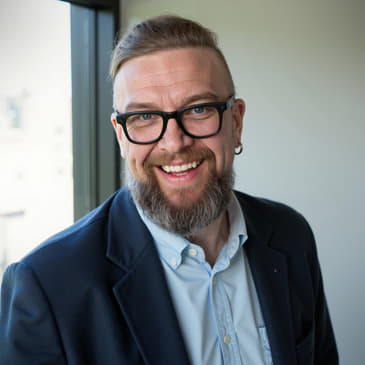
Dr. Adam Hazlett is an Autistic and ADHD professor in humanities at Henry Ford College in Dearborn, Michigan. Dr. Hazlett is a writer and advocate for micro-accommodations, universal design, and Neuro-affirming education. Dr. Hazlett holds a Doctor of Arts in Humanities in 2016, along with graduate and professional certificates in Disability, Inclusion, and Equitable Design (2022) and Neurodiversity (2024). Dr. Hazlett’s scholarship has appeared in both the Detroit News and national academic publications, and leads a public-facing project, NACHOS: The Neuro-Affirming Conversation Hour for Outreach and Support. In addition, Dr. Hazlett serves as Public Relations Director for Self-Advocates of Michigan. Please join me in welcoming Dr. Adam Hazlett.
Philip King-Lowe
Dr. Adam Hazlett, thank you so much for being on this episode of Today's Autistic Moment. This is our first opportunity to talk with you. Thank you so much for being here.
Dr. A. R. Hazlett (Âû)
And thank you for having me.
Philip King-Lowe
Thank you. Yeah, I understand we have a common friend and Carol Jean-Whittington.
Dr. A. R. Hazlett (Âû)
Yes, we do. Yes, we do an amazing human.
Philip King-Lowe
Very much. So, very much. So, I couldn't agree more.
Dr. A. R. Hazlett (Âû)
Yeah, the first time we got to sit down for a one on one, I told her, as we were leaving the conversation, and she, she said, “I want to ask you a question.” And I thought it was going to be one of these, you know, kind of ending conversation questions, like, when can we, you know, meet up again? And it was like, it was like, this philosophical hand grenade, right, of a question that just, and I teach philosophy, and I just was like, Wow, you are quite a human right. I mean, like, they, they write books about you.
Philip King-Lowe
Yeah, absolutely, absolutely. All right, well, this topic is Autistic Joy. We are so due for that moment of setting aside the challenges of our times and all that's going on to talk about Autistic joy. It's hard to say, let me correct that and say it's an understatement to say that Autistics are plagued with the negativity around being Autistic, Autism and Neurodivergence and all that, and we are living through a year where that is overwhelming to say the least. So, what a great topic to talk about, and it is my hope for my audience today that we're going to give them some lifting, something to be proud of and celebrate about being Autistic, so let's dig in here.
Dr. A. R. Hazlett (Âû)
Excellent.
Philip King-Lowe
Yeah, let's build a conversation for this topic today about what does Autistic joy mean for Autistic Adults to be multidimensional?
Dr. A. R. Hazlett (Âû)
Yes, I'm not aware if you saw the I mean, it's all over in our spheres, but the research on Autistic joy that came out last week, I believe it was Elliot Wassell and it was in Disability & Society. It was, again, it just looked at quantifying and qualifying our joy and looking at how that happens. And it basically said the same thing that, you know, the kind of premise of our conversation here, that there is such always a negative view of and discussions and the words that are used around our existence and our experience, right are so nasty. And it looked at the experience of Autistic Joy, and it found that we are overwhelmingly joyful humans who find solace and joy in lots of things and I think that one of the biggest things about Autistic Joy that we need to lean into as Autistic humans is defining it for ourselves. We are given so many words, rules and norms by simple observation, right? Our pattern recognition and our observation, we lock these things in. And I really think that we have to ask ourselves, what brings us joy first? Before we could even figure out, you know, going about the business of expressing that joy in public or even in private. Because I know for years, I thought I was a person who enjoyed road trips, right? I enjoyed the idea of road trips. I didn't enjoy road trips. They caused meltdown afterwards, anxiety before, um, you know, kind of hyper focus during that was not a positive hyper focus. And when I was able to stop by, stop and ask myself, do you really enjoy those things? I didn't. Not the way I was doing them based upon an allistic or nonautistic, you know, view of the world, which it was given to me. So, I think we should look back, look first at defining for ourselves what that means, if that makes sense, right?
Philip King-Lowe
And what does Autistic Joy mean for you and for those, those who may be struggling to find out what it means for them. What do you recommend that they do?
Dr. A. R. Hazlett (Âû)
I think much like we do with our sensory avoidance, right? We either learn or need to learn those things that might be annoyances to us, you know, the lights in a certain room, or the pitch of a refrigerator motor in the one kitchen at grandma's or something like this. Just as we learn that I think we have to kind of do a tasting right and try new experiences, which is not something that I know I lean into right. I get very much in the binary and very much into the pattern or my own patterns and repetitions. But I understanding that I needed to find joy, started to be more curious about what things could bring me joy. So, I think that that for people who are searching for that joy right now, they need to look at taste testing different types of joy, art, music, nature. Because, you know, I know I grew up in a place where everyone said, go out into the woods, go out and I like the idea, and I like being out there, but I don't like getting dirty. So, if I can set up an environment where I can go out into the woods, but yet still keep my feet clean. I get the best of all worlds, and I have found that I am joyful in the woods. I'm not joyful in the woods the way in which it's been given to me or presented to me. So, I think having that curiosity and that freedom from ourselves to try new things to yeah, because often we're told, or we lock in our brains we define I'm not a person who likes to go to the movies until we try it a different way. And there's so many ways in this world to experience even going to the movies, right from drive into private screenings that I think we can lean into as Autistic humans, just having some curiosity.
Philip King-Lowe
Yeah, and last month, Carol Jean-Whittington and I hosted a self-care episode with Michelle Markman, who gave a splendid piece of advice, and that is, if you're unable to find something in the present moment that you enjoy, you might want to take a journey back into some things you once enjoyed in your younger years that other people told you you shouldn't be enjoying that right now, you know, because we're so conditioned to believe them, oh, you're not supposed to enjoy Legos. You're not supposed to have fun with, you know, or enjoy those shows that you saw all the time well. Now, of course, we have DVDs. We have online streaming of shows that were many, many years ago. And this is one of those things that I have been finding some great joy in. I watched a documentary about M*A*S*H, the show, you know, and to be honest with you, when it was on every day, and when I used to see it on UFH channels, for those who don't know what that means, it's just, it's the old channels from before there was cable that they always used to put the repeats on those on those channels every day, you know? So, you'd have something to watch. Well, I watched a documentary about M*A*S*H, and now I'm binge watching the show, and I love it. Okay? So, it might be something that you once enjoyed and just go back to it, indulge in it, and find joy in it, or find or maybe there was something you weren't so interested in but wanted to find out. Yes. That's a great way to find some joy that you might be missing right now, go ahead and comment on that.
Dr. A. R. Hazlett (Âû)
No, I think that that's a perfect mirror, right? Because I was kind of looking at it more from a negative sense, whereas that kind of idea looks at it more positively, right? Because we were told not to, right? And I think that that's brilliant, because of the way in which we've locked in. Even I know that it has taken a while, but even at an unconscious level, right, we take in what other people say. And like you said, Maybe we never even attempted, right? I mean, if you grew up where I grew, I mean, I grew up in Appalachia, and it was very much a, here is what we do, kind of culture. And divergence from that was, was not verbally or physically corrected. It could just be a look, right? It was, it was a, it was a herd kind of correction. And I noticed that herd correction like a border collie. I see, I see the herd going, so I'm going to get over with the herd before the herd does. And so, I think that's brilliant, and it really is. It begs that question again, of why we, why we let them define it for us? And then it made sense. But now, why do we continue? And there is so much power positive power in nostalgia, and especially in in the human brain in general, but there's so much power in that memory and that nostalgia for positive, for positive, even growth here for the future. So, the past does have a key I agree with that wholeheartedly.
Philip King-Lowe
Yeah, absolutely. And you know, maybe you didn't have the chance to collect some things that you wanted to collect. Sometimes you can find those, sometimes you can't, but there's nothing wrong with going back and enjoying them. Maybe you want to journal about them or you know, or journal about what it was that you found some joy in it. How did it when you when you watched it, or when you saw it, what? What feelings did you get? And allow yourselves to have those, those fun feelings, those things that you know really made you fall in love with whatever it is. I mean, you know, there's a reason those special interests mean so much to you. And you know, I heard someone say that they thought that one of the great parts about being Autistic is that nobody finds as much joy or as much meaning in whatever your special interest is the way you do, and that's a good thing, right?
Dr. A. R. Hazlett (Âû)
Right, I think so.
Philip King-Lowe
Yeah, you know, we've, you know, and, and I know it's hard, especially if you're late identified, because you've got so much of your life to really work through. Well, one of the things that can be helpful is, if you ask yourself, I really enjoyed something, whatever it was, collecting dolls, or um, watching a favorite show or indulging in an art or music or whatever, and revisiting those things and just putting aside all those negative messages you were told and just enjoy whatever it is all over again.
Dr. A. R. Hazlett (Âû)
And I mean, I talk about joy in in my curriculum work, and in my other work, I talk about joy is kind of the last perfect and important piece of the kind of puzzle. And I, and I, and I focus on the J and joy, and I and I tell people that part of that J is just being present, right? Because, in order to you know it, because even if you're indulging in a past joy, you can't emotionally perseverate into the past. You can't start to be anxious about the future. You have to be in that moment in order to feel that joy and so to allow yourself to melt away from other people's gaze, or even from your own internal judgment and gaze. I think that's so very important to embracing that joy and getting into that flow state, right, that we, so many of us, find joyful.
Philip King-Lowe
Right. Absolutely, you know, and some of those things you know that even your sensory processing can also be a key, you know you like quiet spaces. You like spaces with all sorts of things, maybe your favorite collections in them, or maybe you are somebody who really liked climbing things that that was your sensory input. That was when you were sensory seeking or whatever that was. I mean that one of those things that forever comes to my mind is that we've been taught by the allistic society to you know, don't make such a big deal out of feeling cold or, you know, you made too much of a deal about that, that shirt I bought you that was uncomfortable, you know. And really what was happening is that your body was telling you correctly. This is not working for me. So, we've internalized that message that there's something wrong when I need something that makes me comfortable, or I need something that gives me that joy, that gives me that energy that you need. And so, you know, you know, part of your discovering your Autistic strengths, if you will, is by listening to your sensory processing, telling you when something is right, and being attentive to what if your sensory processing is saying this is not fitting me right now. You know, I think, I think what we need to say very particularly is that your Autism can already bring you joy. It's just a matter of getting past those negative messages, even the negative messages we are hearing ad nauseum today, and just learning to look at yourself looking at how being Autistic isn't only okay. It's wonderful to be Autistic.
Dr. A. R. Hazlett (Âû)
You couldn't have said, I mean, honestly, it is integral, right? I mean, the way in which I hear music, I know is different from other people, because when I ask and I sing back apart, and I'm like, listening with my partner, and I say, do you hear that? Do you hear that drum? Or do you hear that? And nope, nope. And we'll listen to it again, and she'll put on the hair, the headphones in it, and I know that it's my ear, and it's the pattern, and I'm and I'm like, wow, she doesn't get to get that little feeling in her stomach when she hears that song. Oh, I feel so poorly for her.
Philip King-Lowe
Yeah.
Dr. A. R. Hazlett (Âû)
Yep. And so, I started to reframe it that way, and I started to think, Oh, aren't they? Aren't they? You know, Isn't that sad that they don't get to experience this this way, and that they don't get to, you know, feel the music in the way that I do, and get the goosebumps in the way that I do. And I was, you know, and you'd mentioned the, you know, that it's kind of, it's important to who we are, that research that I was talking about earlier, it was like, let me, yeah, 94 I just have written over here my whiteboard, 94% said that it was integral to who they are, or that that Autism was integral to how they express and experience joy. That it's that there was this overlap that they couldn't pull apart. Because I think, like we're kind of saying it is how we see the world, so it is that's the only way that we can experience joy, right? Which is why I demand we redefine it. We have to take it back and say, This is our joy. This is what it looks like for us.
After this next commercial break, Dr. Hazlett will answer a question as to how Autistics who are in situations where their caregivers stifle their joy can still find enjoyment in who they are.
♫ Segment Ending Music ♫
Commercial Break II
♫Best Care Ad♫
♫MICC Ad♫
♫ Autistic Coach Collective Ad ♫
TAM Support Ad
This past week, the Autistic community was harmed by news that results in more thwarted belonging. Autistics exist because our brains are unique and contributes to the common good of society in ways that only Autistic people can. Now more than ever, the Autistic community needs you to step forward through your financial contribution for Today’s Autistic Moment.
Here are some ways you can support Today’s Autistic Moment.
· Make a one-time donation through the Ko-fi icon when you tap on Support Today's Autistic Moment on todaysautisticmoment.com
· Subscribe monthly via Patreon.
· Purchase items at Today’s Autistic Moment’s Logo Shop.
· Share Today’s Autistic Moment with your family, friends, coworkers and others through social media and/or by telling others about us.
Donations are not tax-deductible but help keep Today’s Autistic Moment as a safe space.
Thank you for supporting Today’s Autistic Moment.
♫Segment Beginning Music♫
Segment 3
Philip King-Lowe
I want to reach into our second question, which is going to be so important, and that is Autistics being engaged in Autistic joy, and we really were kind of going in this direction. Our intersectional communities are also being attacked and getting so much negativity in the press from all angles here. You know, I have been overwhelmed by what's happening to our Autistic Trans Communities this year and so, you know, when so many of our identities are experiencing this overwhelming negativity how do we keep engaged in this in a way that brings us joy?
Dr. A. R. Hazlett (Âû)
So, I think one of the ways in which we engage that community is to make better yet schedule time for joy. When I think back to my mentors who taught me about organizing, taught me about leadership, all of these things, and they were mid-20th century people, so they had worked with Eleanor Roosevelt. They had stood up in the 60s in desegregated schools. They fought for the ERA. Those things they said one of the most important things that we remembered to do, because in the morning, right we would bury the people that we lost. In the afternoon, we would protest the reasons that we'd lost those people, and at night, we would celebrate all of it. And I think that what we need to do is get in the habit of making that joy a predictable part of our schedule. Building it in to where we say we're gonna do something joyful, creative, something that feeds our brain good food, right? Because we can stim in, you know, in a positive way by flapping, or we can stim in a negative way by chewing our fingers down to the bone, right? And so, I think focusing on and leaning into, and, I dare say, scheduling joy, yeah, because it doesn't have to be spontaneous.
Philip King-Lowe
Right. I'm gonna throw my curveball question here for you, because as you're talking, and I love what you're saying, let's say you happen to be in the same household with someone who is your caregiver. You don't really have the financial resources to move out or find someone else who will positively look after yourself. Just finding a space where you know, you can be alone or, you know, do some of your own things. How do they schedule joy into their time? How do they, you know, make their time or find the joy in things when they have somebody who is always looking at them and saying, turning off your show or taking your headphones off on you, or things like that. Can you give any ideas for them?
Dr. A. R. Hazlett (Âû)
Well, I mean, one I would, I would remind people that, and this is maybe not strictly for the people that are in that situation, but everyone is that digital spaces are real spaces too, right? So, I think a lot of people learned that a couple years ago, but have forgotten it. I think that in those situations, it is, and I'm trying to figure out a way I think that it is. It's a disconnection from joy from both parties. And again, I'm not concerned particularly about the joy in this conversation of the caregiver, but we know that it's integral to the reciprocation of that and the resonance of that, because even if I'm joyful, if, even if I'm even if I'm in that flow state, and I'm vibing off of the emotions of others that can pull me out of that, right? So, I, you know, in those situations, I think that's where that's, you know, and I know the hard conversations, because those conversations sometimes have power related to them, power over one's person, power over one's legality, and all of these other things. But I really think that that is also where a conversation, or communication between that person and that caregiver about even their joy could maybe start to build a bridge maybe start that is such, because when you throw in that X factor of that caregiver and that other human right, when we have a hard time even understanding ourselves, and then that other person obviously doesn't understand us, we don't understand why they don't understand us. Yeah, compiles it to and that's a heck of a curveball.
Philip King-Lowe
It is. But you know, right now, there are, there are people who you know, you know might be, nonspeaking, whatever it is. So, they're, they're feeling like they're at a disadvantage, and I don't want to say that they are and offend anybody, but it can feel that way, and we're in a time right now where the dominating cultures have gained a lot of power that they shouldn't have in the first place. And so, you know, really working through these times and being in that situation where nobody's listening to you, nobody's answering you in a way that is rational, which is part of the problem, um, you know, you know, um, it's difficult. And let me remind everybody that when someone is irrational, they can't exactly hear their truth when you're talking or when you're listening, because someone who is irrational can't hear you. They can't reply in a way that is going to be constructive. So as best as possible, it's important to put yourself in a place where you can deal with yourself. And that's one of those places you find some joy. Um, sometimes it really does involve as best you can, finding a space that they simply cannot cross, you know, and one of the things that you can do, absolutely can do is start making your boundaries and making those boundaries very specific. You know, I mean, I came from a household where everybody was pretty irrational, and believe me, it was, it leaves a lot of trauma in people's minds, and it's difficult to work passed. But even sometimes, in a situation like that, you can find at least one or two spaces where you're kind of left on your own devices to do what you feel you have to do. So, I feel like we owe it to the audience that just heard this question. You deserve a better answer in many ways than what we're giving you, but we also believe that there is somewhere that you can put yourself so that you remain the rational one, even though the other is completely irrational. Okay, you cannot force someone who is irrational to be rational. They have to come to that space themselves. So, you know, you're free to add, add to anything of that.
Dr. A. R. Hazlett (Âû)
I just find it funny that or not funny, I find it kind of sad that we right again, are always it's impressed upon us to control ourselves and lower our voices and control this and don't think that way and don't act that way and don't react this way. But yet, the more, the more I learn how to deal with my own right dysregulation amount I see in other people, and I just, like you said, they are all irrational. And it's, it's got me a little head shy about going out in public, is so much but, but it really is, like, I start to notice. I'm like, wow. And so, it really is, it is important. I think, like you said, to focus on where we can go, even if it's you know, even if it's places that you know aren't, you know, physical, even where we can go to find that solace while the irrationality happens.
Philip King-Lowe
Yeah, you know, sometimes it could be some square breathing, the kind of breathing where you just sort of draw a little box some place, and you breathe in some air for five seconds, you hold it for five seconds, you let it out for the next five seconds, and then you sit there for five seconds, and then you start it over. That can relieve a lot of anxiety, and basically change the oxygen inside yourself so that you can again, sort of come back to your space where you can be rational with yourself. And you know sometimes, you know when the irrational one is speaking sometimes you just might have to do it on your own in that space, close your eyes and you know, here's one tip I've learned. I've noticed sometimes if somebody's really being irrational with me, if I close my eyes, and I just breathe in some deep air and just I'm not even listening to that person anymore. Sometimes that person will just give up and stop talking, and that's exactly what you want them to do, right? You know you want them to stop talking. You want them to stop nagging. Sometimes, if they feel like you're not even hearing them, they'll give up. Okay?
Dr. A. R. Hazlett (Âû)
You go to another place, right? And they see that, and then, yeah, the futility of their of their irrationality.
Philip King-Lowe
No. And how you find joy in a situation like that is just being in that space where you're with yourself, eyes closed, or thoughts somewhere else, and just indulge in that thought and make yourself happy and at that point, don't even worry about the other right at that point, and just be, you know, yeah, these are just because of the times we're living in, and it they're not simple. And by all means, there is no perfect solution, unfortunately. But you know, the point is, as you've heard Becca Lory Hector say many times. Don't worry so much about what you can't control, but do take control of what you do have control over. You do still have control over yourself. You do still have your space yourself, and that's what you need to invest your energy into and I think we're, we're Dr Adam Hazlett, and I that's exactly what we're saying.
Dr. A. R. Hazlett (Âû)
Yeah. Yes. 100%.
Philip King-Lowe
Yeah, definitely. And in my third point, which is always about interdependence, interconnectedness. I want to say that one of your first places of finding Autistic joy is to connect with other Autistic individuals, to really connect with the other people who validate you. I'm going to let Adam answer, but I want to say I'd like you all to know that over the past five years that I've been hosting Today's Autistic Moment, my joy in this is from the amazing Autistic people and our professionals who support us, truly support us. This gives me such joy. It gives me so much power to really take care of myself in other ways, and that's why, for Today's Autistic Moment, I put the Autistic voices first, okay, because we know that, that with all the stuff we're hearing right now, it's the other Autistics who can bring us relief, because hearing it from another Autistic person, "Hey, I've been in your situation, and this is what I what I did". This is what I do now, and having someone to tell your story to, and someone who's going to validate you, you know, this is where your interdependence goes and that is one of those things, like I say I have interviewed so many amazing Autistic Adults, and whatever their meaning to my audience, it means just as much to me. Because, you know, I have my life that I live, and some days I have my good days and bad days, but listening to other Autistics talk like they do, it really makes a difference for me, and I'm sure that Dr Adam Hazlett can say the same thing.
Dr. A. R. Hazlett (Âû)
I completely agree, knowing that I am not alone in my, in my aloneness, right, not in my, in my kind of Autistic solitude, which I don't think is I don't look at that as a negative thing, right? Because solitude was something that was told to me as a negative thing, right, just as we've been saying today. So, I think that that, yes, I completely agree that the idea is, is connection and reconnection really?
Philip King-Lowe
Yeah. Yeah. Yeah.
Dr. A. R. Hazlett (Âû)
Yeah, reconnecting, I mean, with us, with ourselves, right?
Philip King-Lowe
I want to talk about that word solitude for a moment. Some of you in my audience have heard me say, I am a monastic, and that's true, and that's where solitude. I want to put the positive spin on solitude, Saint Moses of the Desert. I'm not talking about Moses who led the people of Israel through the sea and all that. I'm talking about a different one. Had a phrase that he used. "Sit in your cell, and your cell will teach you everything." And what he meant by the word cell physically was his own space, but he's actually talking about your heart. You know sit in your heart, and your heart will teach you everything, okay? And the reason the Desert Fathers made their impact is because when you're in the desert, when you're alone in your heart, you are confronted by the truth of who you are, you can't escape it anymore. Okay? That is not a negativity. That's actually a good thing. When you're in that space by yourself, the masks come off, the pretenses come off. Everything comes off and you see yourself as you are. And the thing is, Autistics are often in some kind of solitude. The positive side is you get to see yourself as you are and find joy in that existence that's we're talking about. From that can come opportunities to socialize with the Autistic community, all of whom are listening to their selves or struggling to listen to yourself, and that's part of the piece too. But oftentimes for us, Autistics, when we meet the rest of the Autistic community. It's our opportunity to actually find some community from the point of our solitude, that point of when we were alone with ourselves and, um, hmm, you know you need to be especially patient with yourself as you find joy in the Autistic community. One of the things to remember is that there will be some Autistic so you just don't do well together, but you will find someone with whom you do. And there is so much Autistic joy in just being honest with other Autistics and hearing someone say, "I have that problem too. That happens to me too." Dr Adam Hazlett, go ahead and talk from your point of view.
Dr. A. R. Hazlett (Âû)
No, no. I was just yes, I just yeah, because that resonated with me, because that's, that's kind of what I meant with you know, not being alone in your solitude, right? Because you can, you realize that other people have had those solitary experiences, and then there's this collective kind of shared wisdom experience. Because even though you have come to know yourself in your cell the way you did, and me and my cell the way I did, and someone else in their cell, we still had that experience of going into the cell, even if they look different, even if, and we can share that, you know, that kind of journey together, and what we have learned along the way, and the different dragons and unicorns and all the other things that we've come across and, yeah, it is. It gets me, it gets me excited about, you know, meeting people, which is something that used to be something that would terrify right? Because, as you said, you're not going to find every Autistic person that you, that you mesh with, but that's where I go back to that sampling thing. Well, then I got to meet more people, right? You know, I got to meet more Autistic people then, because there's gotta be more out there that I do mesh with.
After this final commercial break, Dr. Hazlett will talk about the humanities organization he is part of. Today’s Autistic Community Bulletin Board will follow.
♫ Segment Ending Music ♫
Commercial Break III
♫Lisa Morgan Consulting Ad♫
Future Shows
October is Disability Employment Month. On October 12th, Michael Goldberger, an Autistic and graduate from Minnesota Independence College & Community will be my guest for the episode An Autistic Business Owner’s Story. A year ago, Michael Goldberger started a surplus business where he resells items on platforms like eBay, Poshmark, and Mercari. Michael will talk about how MICC helped him develop his communication and people skills. Michael will emphasize the importance of interdependence within the Autistic community for business growth.
October is also ADHD Awareness Month. Tyler Hackner another student from Minnesota Independence College & Community will be my guest on October 26th for the episode Autistic and ADHD: The Strengths and Challenges.
Thank you for listening to Today’s Autistic Moment.
♫ Segment Beginning Music ♫
Segment 4
Philip King-Lowe
Dr Adam Hazlett, before we wrap this up today, do you have any resources that you would recommend, websites, books about Autistic joy that you can recommend to our listeners?
Dr. A. R. Hazlett (Âû)
Well, as I mentioned before, there is, there was a recent, again, Autistic led research project about Autistic joy. Again, I always look at research done by us, for us, right? And that was in the journal disability and society, and it's, again, just entitled experiences of Autistic joy. But I weekly work on this in my community and with my research, and that can be found at humanities101.org. And at humanities101.org, again, what we work on is application of Autistic joy in everyday life. Making sure that people have a space where they can start to ask themselves, What makes me happy? And then unabashedly and without trepidation, answer those questions and have the freedom to answer those questions, because I think it's important, again, as we mentioned, simply to provide the space for that to happen.
Philip King-Lowe
So, would you repeat that? Repeat that website again?
Dr. A. R. Hazlett (Âû)
Yes, that is humanities101.org, so it's h, u, m, a, n, i, t, i, e, s, 1, zero, 1. o, r, g, and that's basically just a nonprofit that I started again, kind of to protect intellectual property and my own, you know, kind of ideas and experiences, but as a way to kind of codify curriculum, design work and communicate these messages that are all out there, but to communicate them to the academic community. Because, again, one of those silos that don't listen to us but talk about us a lot.
Philip King-Lowe
Humanities101.org will be included in the Adult Autism Resources Links page on todaysautisticmoment.com and you can read more about the work of Dr Adam Hazlett. And also, you know, find some community there, and workshops, research resources, surveys and so much more that you can find there. So do look for it in the Adult Autism Resources Links page, and the link will be available on the transcript itself. Dr Adam Hazlett, thank you so much for visiting us on Today's Autistic Moment. This has been a marvelous conversation that I do believe that our audience will indeed appreciate so thank you so much for this.
Dr. A. R. Hazlett (Âû)
Thank you for having me. It was a truly fabulous conversation and a wonderful way to spend my time today. Really, I hope we can do it again.
Philip King-Lowe
I don't see why not, excellent, yeah, but yeah, so definitely.
Transcribed by https://otter.ai
Did you enjoy my interview with Dr. Adam Hazlett? Would you like to listen to the complete interview without the music, the first segment and no ads? Go to todaysautisticmoment.com create an account and subscribe to the new Ad Free & Complete Interview Plan. The subscription is only $12.00 a month or $144.00 for a whole year. You can listen to the shows from July through this and all future episodes. Look for the logo Today’s Autistic Moment Ad Free Interviews.
Today’s Autistic Community Bulletin Board
All these events and many others not mentioned here with their links are available on
todaysautisticmoment.com/bulletinboard.
The Adult Coffee Club for Autistic Adults in Minnesota are held on the second Tuesday of every month (weather permitting) at Dogwood Coffee located at 2700 University Ave W. Suite 100 in St. Paul, Minnesota. The Zip Code for your GPS is 55114. The Adult Coffee Clubs will begin at 4pm to 6pm on October 14th. December 9th. January 13th. February 10th. March 10th.
Understanding Autism virtual classes are offered by The Autism Society of Minnesota. The next classes will be on October 12th 10-11am. November 9th, 12-1pm. December 14th, 6-7pm. January 12th, 10-11am.
On Thursday, October 9th beginning at 8am to 12pm Beth Pitchford will present a workshop at The Autism Society of Minnesota entitled Now and Venn: AuDHD and Overlapping Neurodivergence. Learn the basics of what AuDHD is as well as the strengths, challenges, and idiosyncrasies of being doubly Neurodivergent in this virtual workshop.
The Autistic Community Summit will be held on Saturday, November 8th at Dakota County Technical College located at 1300 145th Street East in Rosemount, MN 55068. Created and led by Autistic people, the Autistic Community Summit is a day build for us-by us. The event will have group sessions in two tracks: Advocacy and Community. You are welcome to move between the tracks to create the experience that fits your needs best. Register today to attend the event where we’ll create a space that is neurodiversity-affirming, community-centered, and full of possibilities.
On December 4th, beginning at 9am to 12pm there will be a workshop at The Autism Society of Minnesota entitled: Eating Disorders and Autism: Understanding the Overlap and Supporting Recovery.
Go to ausm.org to download the Fall Programs Guide with information about these and other social and recreational programs, educational events, counseling services and support groups at The Autism Society of Minnesota.
MNeurodivergent is a social club rooted in a vision of bringing Neurodivergent Minnesotans together to build meaningful connections. Its core principle is to foster an environment where all are treated with dignity and respect regardless of ability or preferences. Go to their website mneurodivergent.org for more information, become a member, volunteer and attend their events.
Register for MICC’s 8th Annual Independence 5K run/1-Mile Walk on October 4th at Donaldson Park in Richfield, Minnesota. This is more than a race—it’s a powerful community gathering to support MICC’s mission to educate and guide Autistic and Neurodivergent Adults in creating and sustaining the lives they want to live. From competitive runners to casual walkers, enthusiastic cheerleaders to dedicated volunteers, everyone plays a vital part in this family-friendly event. Whether you’re racing for a personal best or cheering from the sidelines, your involvement helps amplify Autistic and Neurodivergent voices, foster acceptance, and support lifelong independence. Bring your friends and families, lace up your sneakers, and be part of this most impactful MICC Independence 5K yet. Learn more and sign up at micc.org. Donaldson Park is located at 7434 Humbolt Ave S, Richfield, MN 55423. Check in is at 9:00am. The race begins at 10:00am. Regular registration is $40.00 now through October 2nd. Registration on October 4th is $45.00.
Today’s Autistic Moment is here because of the generosity of supporters and sponsors. Go to todaysautisticmoment.com and select Support Today’s Autistic Moment to donate.
If you have questions about Today’s Autistic Moment, please send an email to todaysautisticmoment@gmail.com.
Thank you for listening to Today’s Autistic Moment: A Podcast for Autistic Adults by An Autistic Adult.
May you have an Autistically Amazing day.
♫ Closing Background Music with credits ♫
All of the guests meet with me on Zoom to record the interviews. The interview transcripts are provided by Otter. The podcast is prepared and edited on WavePad Masters Edition by NCH Software. The podcast is published by Spotify for Podcasters. The music that you hear is licensed to Today’s Autistic Moment by premiumbeat.com.
